Thursday, June 21, 2012

Why China’s Great Economic Boom Is Ending


Another good article from Richard Duncan. 
It seems that the commodity boom will be ending soon as the world economy growth slows down. i think the economic equation is as follows:


Supplier        =================>  China          ===============> US/Europe

Supplier 1 = Advanced economy (Japan, German, US, Korea) that produce machines and tools to be install in China for   production capacity


Supplier 2 = Supplier to Supplier 1, mostly emerging economy (Malaysia, Thailand, Indo, Taiwan) supplier semi finished goods to Supplier1


Supplier 3 = Natural resources and commodities suppliers to China for production.

China - the enormous amount of goods are produced in China for the last 20 years. Most of them were consumed by US and Europe due to the strong currencies and high purchasing power. In another word, US and Europe has high credit rating to borrow to spend. But the borrowing capacity has hit the sky or rather the moon. This era is declining rapidly. 

US/Europe - it is known facts that these two region is in deep trouble. As the demand for China goods reduce, China will reduce the products and services from Suppliers 1,2 and 3. As a results the wealthy effected generated for the last 20 years will subside. 

Repercussion - Price real estates and other forms of real investments will be peaked. 
 ========================================================================
Posted on: Friday, June 15, 2012|Written by: Richard Duncan


The structure of the Chinese economy is very different from that of the US economy. China’s economy is dominated by and driven by investment. The US economy is dominated by and driven by consumption. As I outlined in Economic Forecasting, 101 (February 15, 2012), the economy of every country is comprised of just four major parts: personal consumption expenditure (how much people spend), business investment, net trade (exports – imports) and government spending. The following table shows the composition of the US economy and the Chinese economy:


The breakdown of the US economy is fairly representative of all developed economies (although a bit heavier on consumption than the average). China’s economy is unique in being so heavily weighted toward investment. The key to China’s rapid economic growth over the last two decades has been its surging trade surplus with the United States, which rose from $10 billion in 1990 to $268 billion in 2008. China’s overall trade surplus with the world, shown as “net trade” in the table above was equivalent to 4% of China’s GDP last year. While 4% is not an insignificant number, it would not seem to be large enough to justify my claim that this has been the driver of China’s rapid economic growth; and taken by itself, it would not be.There is much more to it than that, however.
Consider first that there are millions (if not tens of millions) of Chinese factory workers employed in factories making goods to sell to the United States. Those workers are paid a wage. They consume with that wage. That spending boosts China’s economy and appears as “consumption” in China’s GDP statistics.
Next, hundreds of billions of dollars have been invested to build factories in China each year. Many (most?) of those factories make things to sell to the US. That investment boosts China’s economy and is recorded as a business investment in China’s GDP statistics.
Finally, when Chinese exporters bring back the dollars they earn from selling their goods in the United States, they convert them into the Chinese currency, the Yuan, and deposit them in Chinese banks. This causes very rapid deposit growth, which, in turn, forces the banks to have very rapid loan growth (because the banks must earn interest on the loans to be able to pay interest on the deposits). In that way, the rapid loan growth creates very rapid economic growth.
Therefore, in my assessment, as much as 40% of China’s economy is directly dependent on China’s trade surplus with the United States. Now that the US is in crisis, that trade surplus is not going to continue skyrocketing as it has since 1990. It is going to flatten out; and that will create a much more difficult economic environment for China during the years ahead.
China’s industrial output has expanded by more than 15% a year for two decades. Now, given rapidly slowing export growth, the end of the property construction boom, and following a 60% increase in total bank loans during 2009 and 2010, China has massive excess capacity across almost all its major industries. Therefore, there is little reason for it to invest and create even more excess industrial capacity.
The US is in crisis, so the overly indebted Americans can’t continue buying more Chinese goods. Chinese factory workers don’t earn enough to buy what they make in the factories where they work. In fact, roughly 80% of the people in China earn less than $10 per day. Therefore the Chinese can’t afford to buy any more Chinese goods. So, who will?
If China continues to invest and expand its industrial production at 15% a year as in years past, then in three years from now, China will have 50% more industrial production capacity than it does today. That won’t work. China already has too much capacity. The Americans are no longer able to borrow more and buy it all; and the Chinese don’t earn enough to buy it themselves. This all means that the era of rapidly expanding economic growth – driven by investment and exporting – is coming to an end for China.
Economic booms tend to be followed by economic busts; and big booms tend to be followed by big busts. Thailand’s boom ended in 1997. In 1998, its economy shrank by 10%. Such a severe economic outcome cannot be ruled out for China in the near future. However, given the firm control that China’s leaders have over the economy and the political system, such a severe outcome will probably be avoided. China’s leaders are likely to respond to the crisis in China’s export-led, investment-driven economic model in the same way that the Japanese government did when Japan’s great economic bubble popped in 1990; that is through massive fiscal stimulus financed by government borrowing. When Japan’s bubble popped, the Japanese government borrowed and spent and, in that way, prevented Japan’s economy from collapsing into a depression. As a result, Japanese government debt rose from 60% of GDP in 1990 to 240% now.
China is very likely to follow this Japanese model of post-bubble depression prevention – just as the United States has been doing since its property bubble popped in 2008. And, if China’s government borrows and spends aggressively enough, taking Chinese government debt up to 100% or even 200% of China’s GDP over the next decade, China’s economy is unlikely to contract sharply in the way that Thailand’s did in 1998. In fact, it may even continue to expand. It won’t expand at 10% a year as it has over the past 20 years. Nor will it expand at 7.5% a year as the consensus now expects. It may expand by an average of 3% a year over the next ten years, but such a positive outcome is by no means guaranteed. Considerably worse scenarios are also possible.
The very rapid slowdown in China’s economic growth has come as a severe shock to the financial markets. Most economic prognosticators had extrapolated the high rates of Chinese economic growth into the distant future and concluded that China would become the new engine of economic growth for the world. That conclusion has suddenly been called into question by the facts. During April, China’s imports did not increase relative to the same month in 2011. That means China contributed nothing to the economic growth of the rest of the world during that month. This new reality, a world in which China is not importing more each month, has profound implications for the global economy.
It will mean that China will import far fewer raw materials than previously anticipated. That will put significant downward pressure on most commodity prices, everything from oil to copper to cotton. Lower commodity prices will mean significantly less economic growth in the commodity producing countries such as Australia, Brazil and Indonesia; and slower economic growth there will put downward pressure on their currencies. The countries that export precision machine tools to China – such as Germany, Japan and South Korea – will also be hit by the sudden slowdown of Chinese growth. And, as those countries that benefit from exporting to China get hit, they will buy less from their trading partners, so the contagion will spread throughout the world causing trade volumes to decline.
Finally, the property markets in Hong Kong, Singapore, Vancouver, Sydney and Melbourne, which have been bid up by Chinese millionaires, are likely to begin to fall as that source of money dries up.
China’s growth has been derived from its trade surplus with the United States, which was financed by rapidly increasing US indebtedness. That game is up. The world is in shock. Adjustment to this new reality could be swift and savage.
Posted on: Friday, June 15, 2012 | Comments (3) | Written by: Richard Duncan

Saturday, June 2, 2012

Market Pulse


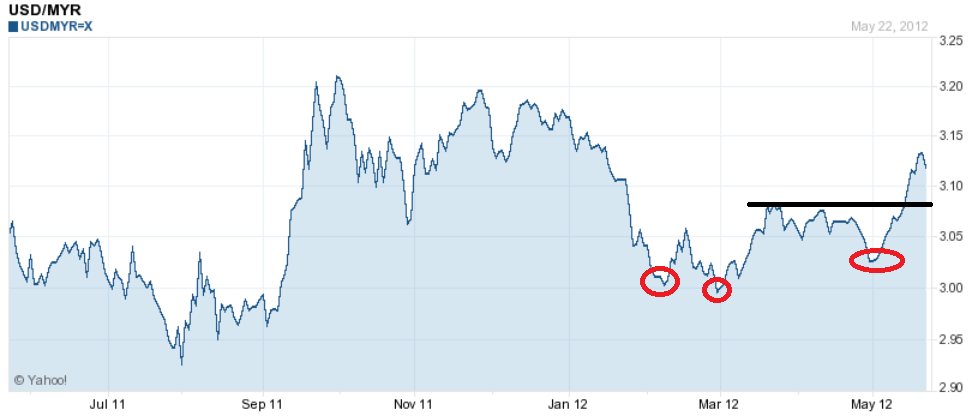
As mentioned in the previous week (28 May - 1 June), there is further upside in USD strengthening due to funds flight that usually happen during uncertain time. USD has strengthen further to 3.20. Well 3.20 level is critical to watch. Should this level to be breached, further strengthening is highly possible. Lets look at 5-year chart below.

Obviously, there is more to come.

 Interestingly, for the first time, USDMRY is moving in tandem with KLCI, it simply tells you that only local funds are buying whilst the foreign funds are leaving KLCI. Hence KLCI rally may not be sustainable in the short run. Be extremely careful.


Dow gave up 2.22% last Friday. Well, hopefully the bloodshed next Monday will be not be that severe! Would be it, we shall see.

Thursday, May 31, 2012

China’s Economy Has Stopped Growing

If you are still bullish on China's growth, please read and re-read Richard Duncan article append below. The known fact now is that US and Europe are broke. Typically, these two region contribute more than 50% of world GDP. See the list below. Should China, the third largest economy slide in slower growth or booming era coming to end, the world may a new "lost decade" faced by Japan. Cautious!


List of 10 Largest Economies in Nominal GDP in 2012 by the International Monetary Fund
Global Rank
G20 Rank
Country
GDP (billions of USD)
Share of Global GDP


  World
71,896.504
100.00%

1
17,070.011
23.74%
1
2
15,609.697
21.71%
2
3
7,991.738
11.12%
3
4
5,980.997
8.32%
4
5
3,478.772
4.84%
5
6
2,712.026
3.77%
6
7
2,452.689
3.41%
7
8
2,449.760
3.41%
8
9
2,066.934
2.87%
9
10
2,021.896
2.81%
10
11
1,804.575
2.51%


China’s Economy Has Stopped Growing


I have just returned from a short trip to Beijing and Shanghai.  My impression is that China’s economy has stopped growing.  If I am right, the consequences for the global economy will be profound.

Since the late 1980s, China has pursued an economic strategy of export-led growth with extraordinary success.  Its trade surplus with the United States rose from $10 billion in 1990 to $268 billion in 2008.  And, with the dollars it earned from that trade surplus, China bought commodities from South America, Africa and South-East Asia and precision machine tools from Germany, Japan and Korea.  Thus, by spending the dollars it earned in the US, China became a “new engine of global economic growth.” 

Last month, China’s exports expanded by only 4.9% compared with the same month last year.  Its imports rose by just 0.1%.  In other words, Chinese demand contributed nothing to economic growth outside China last month.  This was a tremendous change from years past when Chinese imports generally grew by more than 20% every year.  No growth may be the new normal for China.  Export-led growth strategies don’t work when exports don’t grow.  The credit-fuelled booms in the United States and Europe have ended in crisis.  The heavily indebted Americans and Europeans cannot afford to continue buying more from China every year as they have in the past.  I believe this new reality spells the end of China’s great economic boom.

Having a large population with a low average income is not a sufficient condition to guarantee rapid economic growth.  If it were, China (and India) would have become wealthy a long time ago.  Sustainable economic development requires income growth, or, in other words, rising wages.  Wages have been rising in China, but roughly 80% of China’s population still earns less than $10 per day.  The minimum wage in Beijing and Shanghai, China’s two leading cities, was just increased to $13 per day.  Wages are much lower elsewhere around the country. 

Wages are determined by the supply and demand for laborers.  Approximately half of China’s 1.3 billion people still live in the countryside.  Urbanization is taking place, but bringing people into the cities does not cause total consumer demand to rise unless the wages of those people actually increase.  In fact, a growing number of city dwellers could actually push wages down in the cities if there are not enough new jobs to absorb the increasing workforce.  Thus, China’s huge population is a curse rather than a blessing unless a way is found to make average wages increase. 

Since 1990, millions – tens of millions – of Chinese have been employed in factories making things to sell to the Americans.  That increased the demand for labor and allowed wages in China to rise to where they are today.  Now, however, the American households, after increasing their indebtedness from $4 trillion in 1993 to $14 trillion in 2008, are incapable of taking on any more debt.  Therefore, they will not continue to buy more from China each year.  China’s trade surplus with the US is not going to continue skyrocketing as it has since 1990.  Consequently, US demand for Chinese goods is no longer going to continue absorbing more Chinese labor each year.  That means it will not continue to put upward pressure on Chinese wages.  And, if demand from the US ceases to put upward pressure on Chinese wage rates during the years ahead, then what will?

In 2009, the year after the economic crisis began in the United States, China’s trade surplus with the US contracted.  It fell from $268 billion in 2008 to $227 billion in 2009.  This had an appalling impact on Chinese employment.  International newspapers reported that 20 million Chinese factory workers lost their jobs and were forced to return to the countryside to look for work as agricultural laborers.  China’s leaders responded to this destabilizing crisis by allowing China’s banks to increase the total outstanding amount of bank loans by 60% over a two-year period.  Sixty percent loan growth in 24 months!  Just imagine what impact a 60% increase in outstanding bank loans would have on the US economy or the Japanese economy or any economy.  Property prices would skyrocket, everyone would have a job and wages would increase sharply.  But then, a couple of years later, the borrowers would be unable to repay those loans and a banking crisis would ensue.

That 60% increase in total loans, combined with the rebound in the US economy (brought about by trillion dollar US budget deficits financed with trillions of dollars of paper money creation) worked miracles for the Chinese economy.  The 20 million displaced factory workers got their jobs back and China’s economy continued growing by 8% to 9% a year.
But now what?  The global economic crisis is intensifying and China’s export growth is slowing very rapidly.  Within China, the newspapers are reporting that there is no demand for new loans.  That is hardly surprising after the explosion of bank credit since 2009.  That new credit financed an extraordinary expansion of investment and production. As a result, there are now very few profitable new investment opportunities left in China.

After two decades of very rapid investment and production growth, China now has excess capacity across almost every major industry.  On this trip I was shocked by the lack of construction of new high rise buildings in Beijing and Shanghai.  Every other time I have visited those cities, hundreds of cranes were visible on the skyline.  This time, in Beijing I saw one; and in Shanghai, I saw dozens instead of hundreds. 

As I learned during the six years I did research on Thailand’s economy in the 1990s, a property construction boom not only employs a very large number of construction workers, it also affects a wide range of related industries: steel, cement, glass, carpets and sanitary ware being the most obvious ones.  During the boom, all those industries invest and expand their production capacity many fold in order to meet the growing demand for their goods.  That investment contributes to the overall economic boom.  When the construction boom ends, all the industries supplying construction materials are left with massive excess production capacity.  New investment in those industries ceases.  Many of those businesses fail and default on the bank loans they took out to expand their capacity. 

Skyscrapers are easy to see and to count.  Either hundreds of new ones are being built or they are not.  The logic of how a boom and bust of construction affects the related building material industries (as outlined above) is also easy to follow.  However, a boom of capacity expansion in other, non-building related industries is not so obvious.  In Thailand’s case, it was nevertheless just as great as the building boom during the bubble years.  Almost every industry expanded its capacity many-fold.  And, when the boom ended (due to excess capacity relative to affordable demand), every industry suffered from excess capacity and excessive debt.  Many businesses failed.  The Thai banking system spiraled into a systemic crisis as a result. 

After a two-decade long boom of unsurpassed proportions, China is now in much the same position that Thailand faced in 1997.  It has far more production capacity than its 1.3 billion people can afford to buy given the country’s very low wage structure.  As long as China could sell more and more to the United States ever year, its economy could continue to grow.  Now that the US is in crisis, there is no one to absorb China’s excess industrial capacity.  Consequently, there is no reason for China to invest more to build even more excess capacity. That means China’s great economic boom is coming to an end .  Unless rapid economic growth soon resumes in the West – and there is no reason to expect that it will – then China’s leaders will struggle just to prevent a severe contraction of the economy.  China’s “economic miracle” is very close to following the Japanese miracle, the Asian miracle and America’s NASDAQ and property bubbles into the history books as just one more credit induced boom and bust.

Next time I will discuss what the end of China’s great economic boom will mean for the rest of the world.

Wednesday, May 23, 2012

Market Pulse

Market is on correction mode. A double top was formed at 1600 level. The current correction is due to global jittery as the risk of Greece exiting EU has increased. A new socialist government was elected last week.


In uncertain time, there is always funds flight, where funds are flocking back to USD. Looking at the trend, a double bottom, a higher low, USD has more upside.

No bailout forthcoming, Khazanah warns MAS

No bailout! you think you want to trust him. Life is really tough in Malaysia. Middle class earn little yet need to pay high taxes. Worst is still openly oppressed by all these Monsters! These Monsters just has no brain, how can you take general public hard earn money to support a small portion of people who do not deserved it. The most interesting part is after the flip-flop of AirAsia and MAS merger, our friend down here still has cheek to say no bail out! Come on lah friend he is the best analyst before, he knows very well that a company can only run well if it is run competitively. Lets come to reality! Accept the fact and move on! It is no point to spin around the issue in MAS.
Azman said the funds MAS could expect to get from Khazanah would be tied to the airline’s performance. — File pic
 
Azman said the funds MAS could expect to get from Khazanah would be tied to the airline’s performance. — File pic
 
KUALA LUMPUR, May 23 — Khazanah Nasional today said its commitment to Malaysia Airlines’ (MAS) recapitalisation exercise is contingent upon the national carrier’s performance.
“We can put in the money but we also need to see results because this is public money that we are talking about,” Khazanah director Tan Sri Azman Mokhtar told reporters at Axiata Group Bhd’s annual general meeting here.
“It cannot be a bail out,” he stressed, when asked to confirm the amount of capital Khazanah could commit to the national carrier’s plan.
Azman also added, “We need to see results coming through; we need to see Malaysia Airlines’ union, management, board and all stakeholders to work together to advance the company.”
The national carrier recently announced a RM9 billion fund-raising exercise to pay for aircraft purchases and to finance its working capital.
Among the plans is the issuance of up to RM2.5 billion in Islamic bonds by June this year.
MAS also had said that if its plans fall short, it would rely on parent company Khazanah Nasional to step in to provide financial support in the form of capital equity injections to finance any unfunded aircraft capital expenditure and also working capital needs. — Bernama

Wednesday, May 9, 2012

Gold

Gold is entering bearish phase. It next support level will decide whether it moving side way or downward. MA 200 has been breached twice. High chance gold will move side way until QE3 is materialised. Otherwise, i believe wealth will slowly creeping back to economy. No matter how pathetic is world economy growth range 2 - 3% at least still growth. But gold does not give any return. Honestly i think gold has been overvalued.

The fear is somehow subdue, the market only jitter for one two days longest one week whenever bad news emerged from Euro Zone. Probably people has been immune to this virus since 2008. People is started get used to crisis nowadays.    

Tuesday, May 8, 2012

PM pledges RM1.69b windfall for FELDA settlers ahead of polls

Reading the head line, really make me boil. Dont you think politicians are the real B....tard. What rights do the politicians have to use tax payers monies to fund political agenda! YOU PAY PEOPLE ONLY WHEN YOU HAVE EXCESS OF FUNDS NOT DEFICIT WHICH MALAYSIA IS CURRENTLY FACING!
 
 UPDATED @ 04:16:58 PM 08-05-2012
May 08, 2012
Najib speaking to the Felda settlers during his visit to Jengka on May 8, 2012. — Picture by Choo Choy May
JENGKA, May 8 — Datuk Seri Najib Razak today announced a RM1.69 billion windfall for all FELDA settlers and staff throughout the country, ahead of FELDA Global Venture Berhad's (FGVH) listing and an expected general election.
 
The prime minister said that all FELD settler would receive a windfall of RM15,000 each through three different phases - RM5,000 for settlers (phase 1), RM5,000 for their wives (phase 2), and RM5,000 for the second-generation settlers (phase 3).

"These (payments) come from FELDA's own strength. We do not utilise government funds.
"Kita usahakan transformasi, bukan reformasi (We are about transformation)," he said to cheers from over 100,000 FELDA settlers here.

The first phase of the handouts to settlers will be executed within the next two to three weeks, Najib told reporters later.

“It will be in cash. The second phase will be announced after the first phase.
“(The) listing will likely take place before the third phase,” he said.

When asked to explain the high windfall amount, Najib said: “When you list, you monetise assets, there are additional funds.”

Najib also announced a special 2½ months bonus payment for all FELDA staff, reiterating that today’s windfall benefited all stakeholders.

“The last phase of the 21st century begins today... so let us stand proud and make FELDA the world’s biggest global commodity.

“Kita tak nak jadi jaguh kampung, kita nak jadi juara seantero dunia (we do not want to become village champions, we want to become champions of the world),” he said.

The listing of the plantation giant was promised by Najib to be a “windfall” for FELDA settlers, a traditional vote bank for Umno.

It is seen as important to ensuring continued support from the settlers in the upcoming general election which widely expected to be held by July.

FGVH is a 100 per cent subsidiary of FELDA, a statutory body under the Prime Minister’s Department.


Thursday, May 3, 2012

  Another good article from Richard Duncan

 Will Our Economic System Collapse?


The answer is: It might. You will help decide.
Our economic system is Creditism. Creditism evolved out of – but is very different from – Capitalism. Economic growth under Capitalism was driven by recurring cycles of investment, profit and savings (i.e. capital accumulation; hence Capitalism). Creditism creates economic growth through recurrent cycles of credit creation and consumption. Creditism has created very rapid economic growth for decades – much more growth than Capitalism could have created over the same period. The trouble is that Creditism is now in crisis because the private sector in the US cannot bear any more debt. A few charts help illustrate these points.
US: Total Credit Market Debt - Up 50 Times Since 1964
Total debt (that is household sector debt, government debt, corporate debt and financial sector debt) first exceeded $1 trillion in the United States in 1964. Over the next 43 years, it expanded 50 times to $50 trillion. That explosion of credit – and the transformation of our economic system from Capitalism to Creditism – would not have been possible if the United States had continued to employ gold as money. However, in 1968, Congress ended the requirement that the Fed back dollars with gold. Afterwards, credit and Creditism reshaped our world. By the way, debt and credit are two sides of the same coin. Every quarter, the Federal Reserve publishes a document called The Flow of Funds which provides a comprehensive breakdown of who owes the debt (the debtors) and who owns the debt (the creditors). Here’s the link:
In our economic system, credit growth drives economic growth. Since 1952, on an inflation- adjusted basis, there have been only nine years when total credit grew by less than 2%. Each time there was a recession; and the recession, it did not end until there was another surge of credit expansion.
Credit Growth Drives Economic Growth
So, the question now is: Will credit begin to expand again? We can determine that by looking at each of the major sectors of the economy to see which ones, if any, can take on more debt.
Non-Financial Sector Debt
Chart 3 shows the breakdown of debt within the non-financial sectors of the economy. The top line shows the increase in the debt of the household sector. Household sector debt rose from $4 trillion in 1993 to $14 trillion in 2008. That expansion of debt financed a surge of consumption in the US that fuelled a global economic boom. Sadly, in 2008, a significant part of the household sector began to default on its debt. As a result, that sector was cut off from any additional debt and forced to spend less; for that reason, the global economic crisis began.
The household sector is the largest and most important sector of the economy. Its debt has now begun to contract. Will it expand again? An individual’s house is generally his or her most important source of collateral. On average, Hhome prices are now down 34% on average across the US. With less collateral, households will have access to less credit. Moreover, the median income in the US is dropping because globalization is putting strong downward pressure on wages. That means households cannot afford more debt. For these reasons, household sector debt is more likely to continue to contract rather than to expand.
The next line on Chart 3 represents the debt of the federal government. It has nearly doubled since this crisis began. Had government debt not risen so sharply, total debt would not have simply flattened out (see Chart 1), it would have contracted significantly and a new great depression would have begun.
The third line shows the debt of the corporate sector. Corporations are unlikely to borrow more and expand their production capacity so long as households are retrenching. The other sectors shown on this chart are too small to matter, so let’s now look at the fFinancial sectors in Chart 4.
Financial Sector
The top line here shows the debt of the Government Sponsored Enterprises, a.k.a. Fannie Mae and Freddie Mac. Their debt rose from $1 trillion in 1987 to $8 trillion in 2008. As they increased their debt, they obtained cash, which they used to buy up mortgages. That created the US property bubble, which, in turn, drove global economic growth. In 2008, however, Fannie and Freddie effectively went bankrupt and were put into “conservatorship” by the government. Their debt is more likely to contract than to expand going forward. So too is the debt of the private sector issuers of asset backed securities, whose debt is shown in the next line. They were largely responsible for the subprime disaster; now, they are largely out of business.
So, what does all of the above tell us? It tells us that the debt of the private sector is likely to contract during the years ahead. The Austrian economists such as Ludwig von Mises and Murray Rothbard, believed that credit creates an artificial economic boom and that when credit stops expanding, the depression begins. In their world, however, where gold was money, credit expansion could only continue for a relatively short period because it was always constrained by the amount of money (i.e. gold) in the economy; and that constraint was tight since gold was always in short supply. Consequently, the credit induced booms and the resulting depressions were relatively short-lived and mild. If only, that were the case today!
Alas, their world is not the world we live in. In our world, gold is not money and it has not supplied a constraint on credit creation since 1968. In our world, credit has expanded 50 times in less than 50 years. That explosion of credit has created a global economic boom without precedent. The credit boom of the 1920s (the Roaring Twenties) lasted only 16 years – from the abandonment of the gold standard in Europe at the beginning of World War I to 1930 when the credit that caused the boom could not be repaid. Consider the severity of that depression when credit ceased to expand. If credit begins to contract now, the depression that our world would collapse into would be, in all probability, worse than that of the 1930s – that is, if there could be anything worse. In the 1930s, US GDP contracted by 46% and unemployment ranged between 15% and 25% for a decade. That depression did not end until US government spending expanded 900% at the beginning of World War II, a war that took 60 million lives.
Is it regrettable that we are in this situation? Of course it is. Were mistakes made? Therey certainly were. We should never have broken the link between dollars and gold. Had we retained gold as our money, we would have enjoyed much less material prosperity over the last four decades, but we would not now be teetering on the edge of a new great depression. Should we just give up, let credit contract and allow the new great depression to begin? Absolutely not! To surrender without a fight to a replay of the 1930s and the 1940s would be the greatest act of stupidity imaginable.
Well, then, what is the alternative? How can credit continue to expand if the private sector can bear no additional debt? There is only one way, only one possible way out of this catastrophe. The government must borrow and invest. If it invests wisely and aggressively, in transformative 21st Century technologies such as solar, nanotechnology, genetic and biotech, the returns on that investment could prevent the collapse of our economic system. And, in the very worst case, where the government wastes every single penny borrowed and spent (no cure for cancer is found, no genetic therapy that reverses aging, no cheap, clean, limitless energy supply), then at least the collapse of our civilization would have been postponed by a decade or perhaps even longer. If we sharply cut government spending now and allow total credit to contract, then our economic system, -- and the world we know, -- will not survive even 10 more months.
In a democracy, the people must decide what our government will do. To lack faith in the ability of government to solve problems is to lack faith in democracy. As a democratic society, we must choose between two alternative paths. We can invest and prosper or we can retrench and collapse. What we, the people, decide to do will determine our fate.

Tuesday, May 1, 2012

Market Pulse


Ringgit just went below 3.05 support level. It is 3.024 now.


Stock market and USDMYR had a perfect negative correlation for the last few months. With Bersih Rally is over, KLCI should be marching towards 1600 level again supported by the strengthening trend of Ringgit. The carry trade shall continue due to the differences in interest rate in Malaysia and US and Euro. It is good opportunity to long FKLI until just before the GE 13.